
Lazarillo de Tormes
"I consider it a good thing that matters so remarkable, perhaps never before heard of or seen, should be brought to the attention of many."
— Anonymous, 1554
The Premise
You're hungry. You've been hungry for days. Your last master — a squire who pretends to be rich — has less food than you. And the blind man who taught you to survive left you a lesson beaten into your bones: in this world, you're either clever or you're lunch.
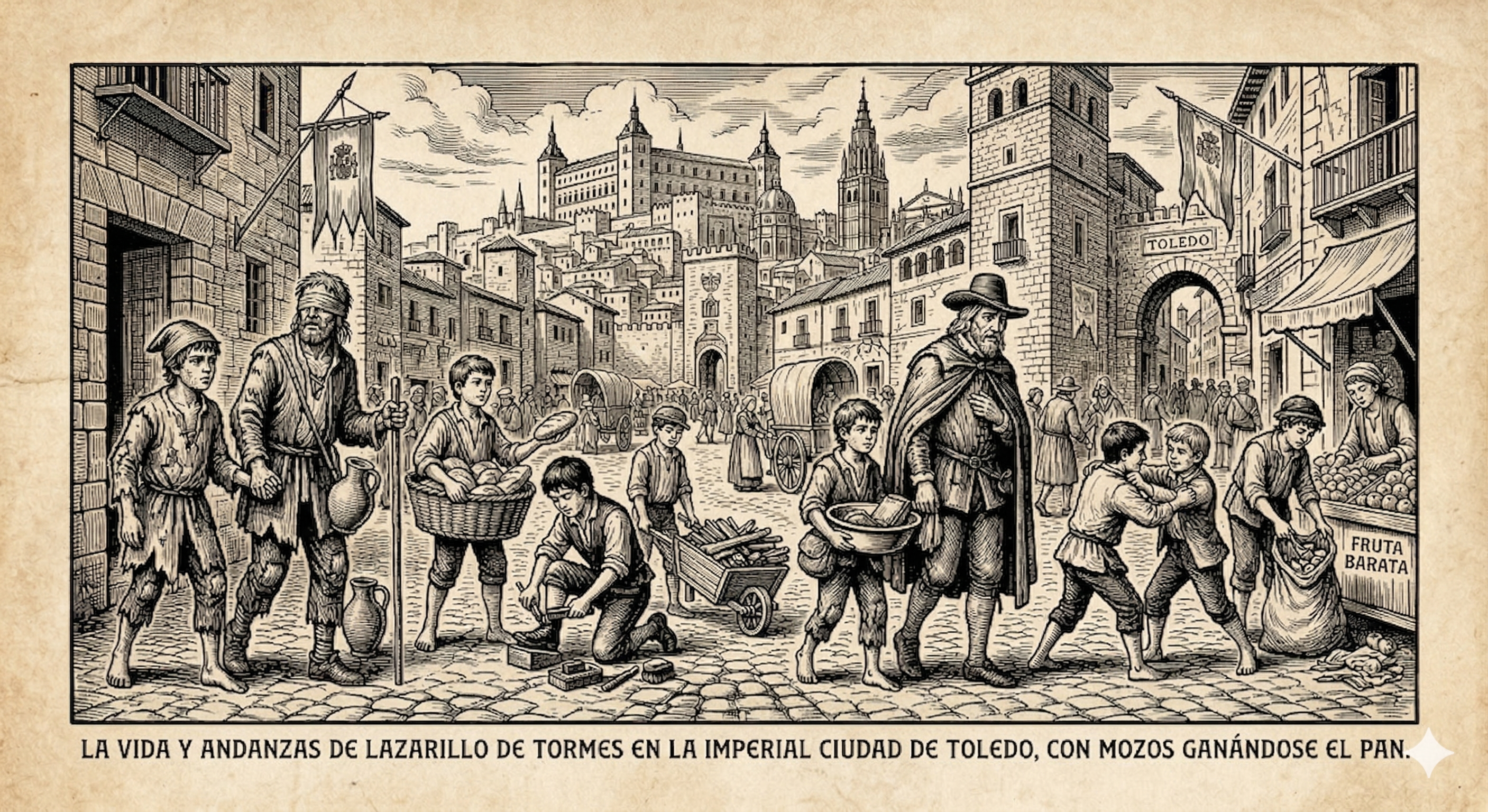
Your class enters sixteenth-century Spain. The streets of Toledo smell of bread you can't afford. A seller of indulgences hawks false miracles in the square. A priest hides food under lock and key. And you — a band of penniless rogues — must make your way using nothing but your wits.
There are no swords or magic. Only your cunning against a world that doesn't want you to succeed. Lazarillo survived. The question is whether you'll be as clever as he was.
The Work
Published anonymously in 1554, Lazarillo de Tormes invented an entire genre: the picaresque novel. There are no heroes, no dragons, no princesses. There's a hungry child who tells how the world taught him, through beatings, that survival is the only honour that matters.
It's a subversive book: it mocks priests, nobles and the blind alike. It was banned by the Inquisition. And five hundred years later, it remains the most honest story ever written about being young, poor and clever in an unfair world. Our escape room channels that energy: you don't need strength. You need cunning.
What You'll Live
- You start with nothing: your resources are your intelligence and your ability to cooperate (or deceive)
- Each "master" is a different challenge: the blind man tests your senses, the priest your skill with locks, the squire your ability to improvise
- The puzzles are traps on a timer — like hunger itself
- You can help each other or compete: the picaresque has no moral rules
- The group that survives with the most wit and fewest scruples wins — just like in the novel